
What if the innovation, economy of scale, competitive advantage, and profitability of your product line were limited only by your imagination instead of your engineering capacity?
Organizations are being pushed to the edge of their capability by the exponentially growing diversity and complexity of today’s product lines — how they are engineered, produced, delivered, and evolved. These variant and complexity management challenges are so large they can impede a company’s ability to achieve strategic business objectives.
Feature-based Product Line Engineering (PLE) is a breakthrough practice that removes this complexity barrier, and BigLever’s onePLE is a holistic solution that removes the barriers to rapid PLE adoption. A growing number of forward thinking organizations are engineering their competitive advantage with the industry leading Feature-based PLE solutions from BigLever. Ask yourself…What is your PLE Strategy?
Time to market.
Leverage major engineering improvements to speed time to market. Target and hit new market windows more efficiently, effectively and profitably than your competitors.
Efficiency & productivity.
Eliminate redundant, repetitive tasks to allow your skilled engineering talent to focus on high value work — and bring a new level of efficiency to your organization.
Product line scalability.
Use feature-based asset sharing and automated production to create new products and product features, and grow your product line — with the push of a button.
Product quality.
Remove human error, simplify and streamline testing and Q&A, and decrease overall defect density to make major improvements in the quality of your product line offering.
BigLever’s onePLE solution.
BigLever’s onePLE is the industry’s only holistic, proven solution to enable rapid and effective adoption of PLE by an organization of any size. It combines our state-of-the-art PLE technology and methods with the business strategy and organizational change needed to accelerate your PLE adoption — so that your organization can fully leverage PLE to create and bring more product innovations to market faster, more efficiently, and more profitably.



BigLever’s PLE Spotlight

Reflections: INCOSE International Workshop 2023
The steady march of Feature-based Product Line Engineering (PLE) from the narrow field of early adopters into the broad mainstream of systems engineering practitioners was on full display at the INCOSE International Workshop (IW2023) in Torrance, California in...
On Display at IS2022: The Fast-Track Evolution of Product Line Engineering (PLE) into a Cornerstone Practice of Systems Engineering
CEO Perspective: Dr. Charles Krueger, CEO and Founder, BigLever Software Since the previous in-person gathering at INCOSE IS2019, important advances have been fueling the PLE fast-track trajectory, a trend I clearly observed at the recent IS2022. Driven by BigLever...
Product Line Processes in an Engineering Tool Ecosystem
In a product-centric environment, it’s common for the same engineering work to be repeated over and over - once for each product in the portfolio to which the work applies. Each time a new requirement is added, a software defect is corrected, or a test case is...

BigLever Announces the Addition of Sales Leader, Jim Browne, to Accelerate Market Expansion
AUSTIN, Texas – September 20, 2022 – BigLever Software, the long-standing leader in Product Line Engineering (PLE), announced today that Jim Browne has joined the organization in the role of Senior Director of Remote Sales. Browne, a veteran sales leader, brings...
BigLever and Vitech Collaborate to Offer Precision Digital Engineering™ Solution, Eliminating a Complexity that Plagues Product Line Systems Engineering
AUSTIN, Texas – May 31, 2022 - BigLever Software, the long-standing leader in Product Line Engineering (PLE) and Vitech, a leading global provider of Model-Based Systems Engineering (MBSE) and digital engineering solutions, announced today the emergence of a...
BigLever Partners with Delligatti Associates to Help Enterprises Seamlessly Incorporate Leading Edge PLE Practices
AUSTIN, Texas - May 17 2022 - BigLever Software, a pioneer and long-standing leader in Feature-based Product Line Engineering (PLE), today announced that it has partnered with Delligatti Associates, an industry recognized thought leader and provider of Model-Based...

“Product Line Engineering has become a critical technology that will have broad impact across the systems engineering field.”
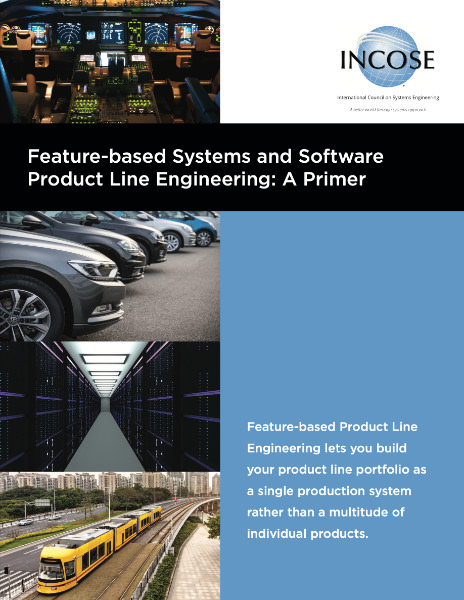
Feature-based Systems and Software Product Line Engineering: A Primer
INCOSE spearheaded the new ISO Feature-based PLE standard 26580. This INCOSE publication serves as an introductory companion to that standard. The Primer defines Feature-based PLE; introduces its important concepts; explains the economic model behind the overwhelming savings it delivers; discusses organizational adoption; and provides sources for more information.
BigLever is pleased to be a contributor to the creation of this publication, which was selected as “Product of the Year” by INCOSE. >> Learn more about PLE and Systems Engineering.
Or, visit INCOSE
Feature-based PLE and ISO 26580
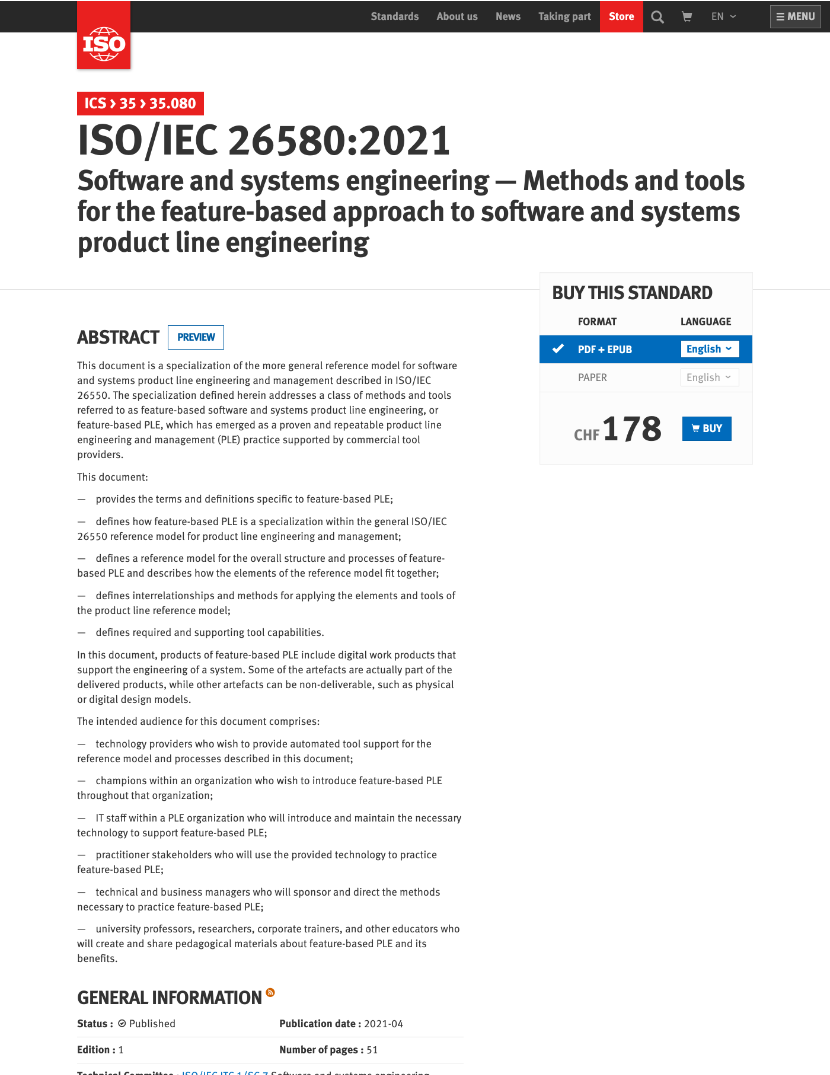
A new industry standard for Feature-based Product Line Engineering has been published by the ISO (International Organization for Standardization) and IEC (International Electrotechnical Commission) subcommittee for software and systems engineering. This new standard, available as ISO/IEC 26580, “Methods and tools for the feature-based approach to software and systems product line engineering”, defines Feature-based PLE according to proven and repeatable best commercial practices, tools and methods.
Feature-based PLE is now being widely adopted into commercial practice by organizations that engineer and deliver complex system families with variations in features and functions, in automotive, aeronautics, medical devices, defense, computer systems, and more. It is a means to dramatically eliminate low-value engineering effort across a system family, so that engineers can focus their time and effort on high-value innovative work that advances product and business objectives, which often leads to significant competitive advantage.
The 26580 standard makes way for widespread Feature-based PLE adoption by providing engineering organizations the confidence to embrace this new model that now has international credibility, validation, and backing of organizations like INCOSE and ISO. ISO has designated that this new standard contributes to the Sustainable Development Goals of ISO and the United Nations. >> Learn more about ISO 26580.